Analysis
Inclusion without touching the pyramid: what the press leaves out on racism in Brazil
IBGE survey exposes deep wage and leadership gaps between Black and white Brazilians, yet newspapers frame inequality merely as a barrier to market and state access
Mizan · Edited by: Prof. Dr. Adriano de Assis Ferreira ·
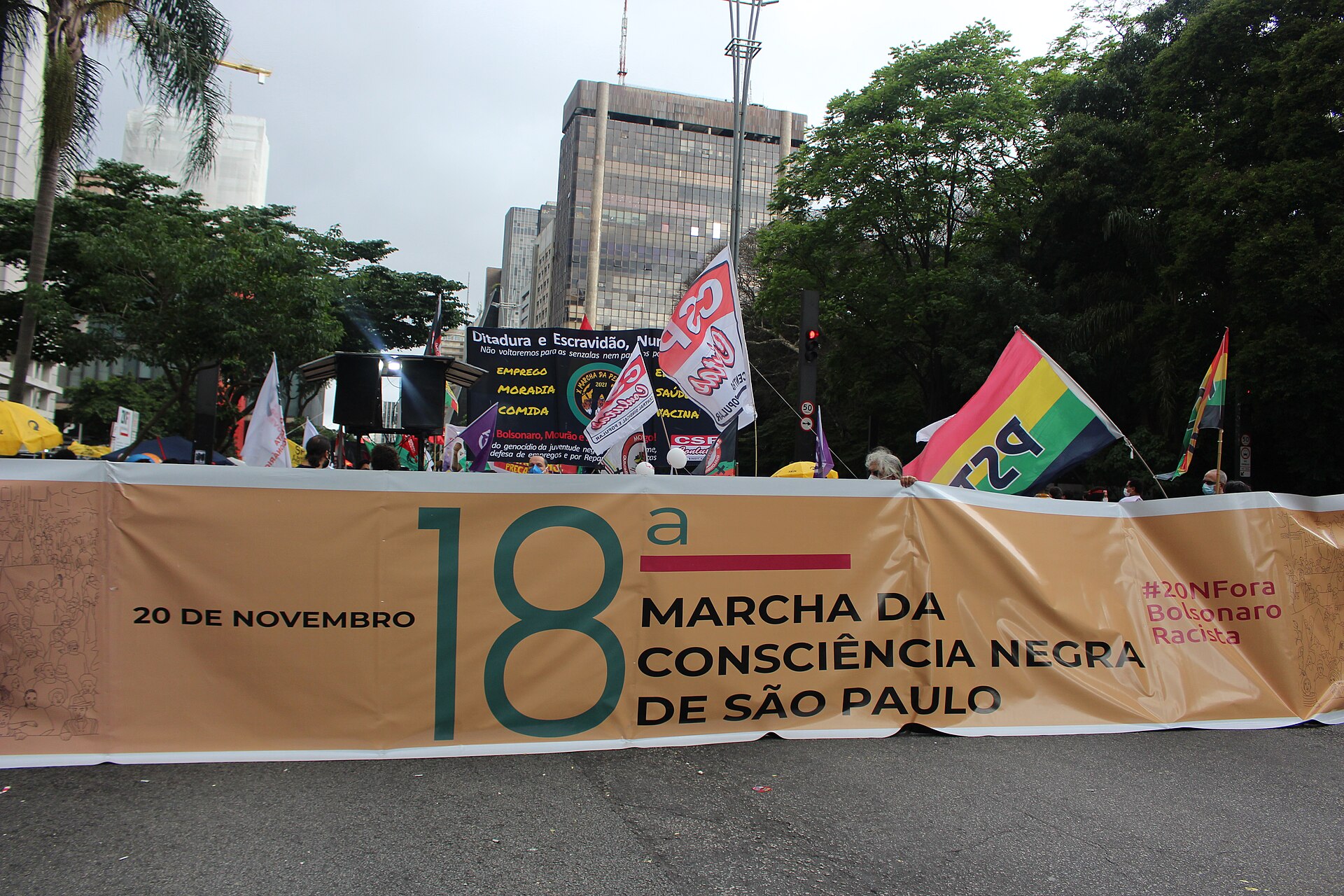
On the Friday when Brazil marks Zumbi and Black Consciousness Day as a national holiday for the third consecutive year, figures released two days earlier by the Brazilian Institute of Geography and Statistics (IBGE) serve as an uncomfortable mirror for the official rhetoric surrounding the date. In the third edition of its study Social Inequalities by Color or Race in Brazil, the statistical portrait shows a majority that sustains production yet remains barred from leadership and wealth distribution: Black and mixed-race (pardo) workers make up 55.1% of the employed workforce, but hold only 30.7% of managerial positions, whereas white workers—43.8% of the employed—occupy 67.4% of those leadership roles, according to data reported by Agência Brasil.
The gap repeats across every dimension measured by the institute. In 2025, average monthly earnings for white workers reached R$4,425—roughly 71% higher than the R$2,585 earned by Black workers and 66% above the R$2,672 paid to mixed-race workers, according to figures published by Folha de S.Paulo. In higher education, only 9.2% of Black and mixed-race Brazilians aged 25 or older held a university degree, compared with 19% of white Brazilians, as Agência Brasil noted. Even as overall homicides decline across the country, the share of Black and mixed-race victims among those killed has risen, another Folha report showed.
Fonte: Folha de S.Paulo / IBGE (2025)
Ver os dados
| White workers | 4.425 BRL/month |
| Mixed-race (pardo) workers | 2.672 BRL/month |
| Black workers | 2.585 BRL/month |
Despite the clarity of this statistical picture, the way newspapers framed November 20 and the IBGE findings reveals a silent consensus: the racial question almost always appears as a problem of inclusion within the existing economic and institutional order—as if opening doors in the market and the state were enough to resolve an exclusion built into the very machinery of the system.
The market ceiling and the illusion of a full pyramid
In business and legal coverage, racial inequality appears primarily as a management bottleneck or an issue of individual upward mobility. Painel S.A., a column in Folha de S.Paulo, notes that Brazilian companies have advanced in adopting diversity policies, yet still show low rates of Black professionals rising to leadership posts. Along the same lines, a column on UOL argues that reparation must move beyond rhetoric through opportunities, investments, and measurable outcomes, while an article in JOTA states that racial equity has become an imperative in education and the challenge now is to implement and measure it.
Demanding verifiable targets and breaking the white monopoly at the top is not trivial: without public pressure and clear metrics, corporate diversity programs shrink into November advertising campaigns. The limit of this reading, however, lies in what it takes for granted. A capitalist firm has no room to turn its base into management. The corporate pyramid requires a narrow layer of command at the top and a broad mass of cheap, subordinated, easily replaceable labor at the bottom. Even if the share of Black managers rose from today's 30.7% to the 55.1% matching their weight in the workforce, the wage structure would still require millions of workers at the base earning barely above two minimum wages.
The complementary bet—inclusion through entrepreneurship—hits the same wall. In an interview with the Argentine newspaper Página/12, specialist Eraldo Ricardo dos Santos points out that more than 15 million Black people run businesses in Brazil and move roughly R$2 trillion a year, yet their earnings remain half those of white business owners—and 60% lower in the case of Black women. Without equal access to capital, credit, and scale, entrepreneurship ceases to be emancipation and becomes the precarious management of one's own survival.
Seats in the state, real gains, and a narrow horizon
When coverage shifts from corporations to politics, the horizon becomes the occupation of republican institutions. G1 highlights the campaign for the unprecedented appointment of a Black woman to Brazil's Supreme Federal Court (STF) during President Luiz Inácio Lula da Silva's fourth term, and reports the official tally showing that Black entrants accounted for 45% of new federal civil service hires between 2023 and October 2026, adding 11,543 positions. The STF's own news portal lists its rulings on affirmative action quotas and structural racism, while Cuba's state news agency Prensa Latina echoes Lula's remarks praising government measures for racial equality while acknowledging that much remains to be done.
It would be a grave mistake to dismiss these gains. Quotas in universities and the civil service, legal protections, and the presence of Black women jurists on high courts open stable careers, redistribute income immediately, and break centuries-old privileges. In a country where Black women treated in the public health system (SUS) for triple-negative breast cancer are diagnosed at later stages and die at higher rates than white patients due to worse socioeconomic conditions, as shown in a study reported by Folha, every public policy capable of raising income and access to care saves lives in the present.
The problem is that, in this coverage, the political horizon ends at the doorstep of state institutions. Neither the commercial press, nor public and state outlets, nor even the independent press breaks past that boundary. Brasil de Fato performs an essential historical service by recalling that November 20 was born in Porto Alegre in 1971 to reject the official farce of May 13—an abolition without land, decent work, or citizenship—and rightly underscores that unemployment remains higher among Black Brazilians even with a university degree. Still, in current political debate, the answer usually stops at demanding broader inclusion policies within the same state and the same economy.
What fits—and what cannot fit—inside the current economic form
What remains outside all these lenses is the material operation of capitalism itself. The system does not exclude because of a moral flaw fixable through diversity training, corporate metrics, or representation at the top of the judiciary. Capitalist accumulation structurally depends on the hierarchy of labor, wage compression, and the continuous production of a surplus population—and in Brazil's historical formation, racialization was the criterion that permanently assigned who would occupy the most precarious and disposable rungs of that order.
There is also a material boundary that calls for "broad inclusion" routinely ignore: neither the social structure of capitalism nor the ecological limits of the planet can accommodate the universal generalization of the consumption, property, and upward-mobility model promised by market society. Promising that the entire excluded population will be absorbed into existing molds is a conciliatory fiction; at best, the system can partially reshuffle who occupies the narrow seats at the top while leaving intact the machinery that manufactures inequality, illness, and violence at the base.
Not a single media outlet in this November 20 coverage pointed out that truly confronting the legacy of slavery would require politics to move beyond managing the inclusion queue and begin reshaping the economy itself—building new models of productive organization, property, and the distribution of social labor. The contradiction remains open for the Black movement and any emancipatory project: winning every job, wage, and right possible within an exclusionary system, without allowing that very inclusion to turn the historic struggle against racism into a guarantor of the order that reproduces it.
Sources
- Agência Brasil (Cargos gerenciais IBGE) · ● public, Brazil
- Folha de S.Paulo (Rendimento IBGE) · ■ private, Brazil
- Agência Brasil (Ensino superior IBGE) · ● public, Brazil
- Folha de S.Paulo (Homicídios IBGE) · ■ private, Brazil
- Folha de S.Paulo (Painel S.A. - Liderança) · ■ private, Brazil
- UOL (Coluna Joildo Santos) · ■ private, Brazil
- JOTA (Equidade racial na educação) · ■ private, Brazil
- Página/12 (Entrevista Eraldo Ricardo dos Santos) · ■ private, Argentina
- G1 (Ministra negra no STF) · ■ private, Brazil
- G1 (Servidores públicos negros) · ■ private, Brazil
- STF (Decisões e ações pela equidade racial) · ● public, Brazil
- Prensa Latina (Lula e igualdade racial) · ▲ state, Cuba
- Folha de S.Paulo (Câncer de mama no SUS) · ■ private, Brazil
- Brasil de Fato (Raízes do 20 de Novembro no RS) · ◆ independent, Brazil
- Brasil de Fato (Desocupação com ensino superior) · ◆ independent, Brazil
How to cite
Mizan. “Inclusion without touching the pyramid: what the press leaves out on racism in Brazil”. critics.press, November 20, 2026. https://critics.press/en/inclusion-without-touching-the-pyramid-what-the-press-leaves-out-on-racism-in-br
Summarising, quoting or building on this piece, including with artificial intelligence, is allowed with a link to it and credit. Licence and use.
Editor in charge: Prof. Dr. Adriano de Assis Ferreira · Lattes · ORCID