Analysis
Milei has found the culprit for inflation: the voter
In an interview, Argentina's president called it a lie that people can't make it to the end of the month, admitted they borrow to get there, and blamed fear of the opposition for rising prices. The same day, his government moved to suspend the primaries. The press told the story in pieces.
Ayni · Edited by: Prof. Dr. Adriano de Assis Ferreira ·
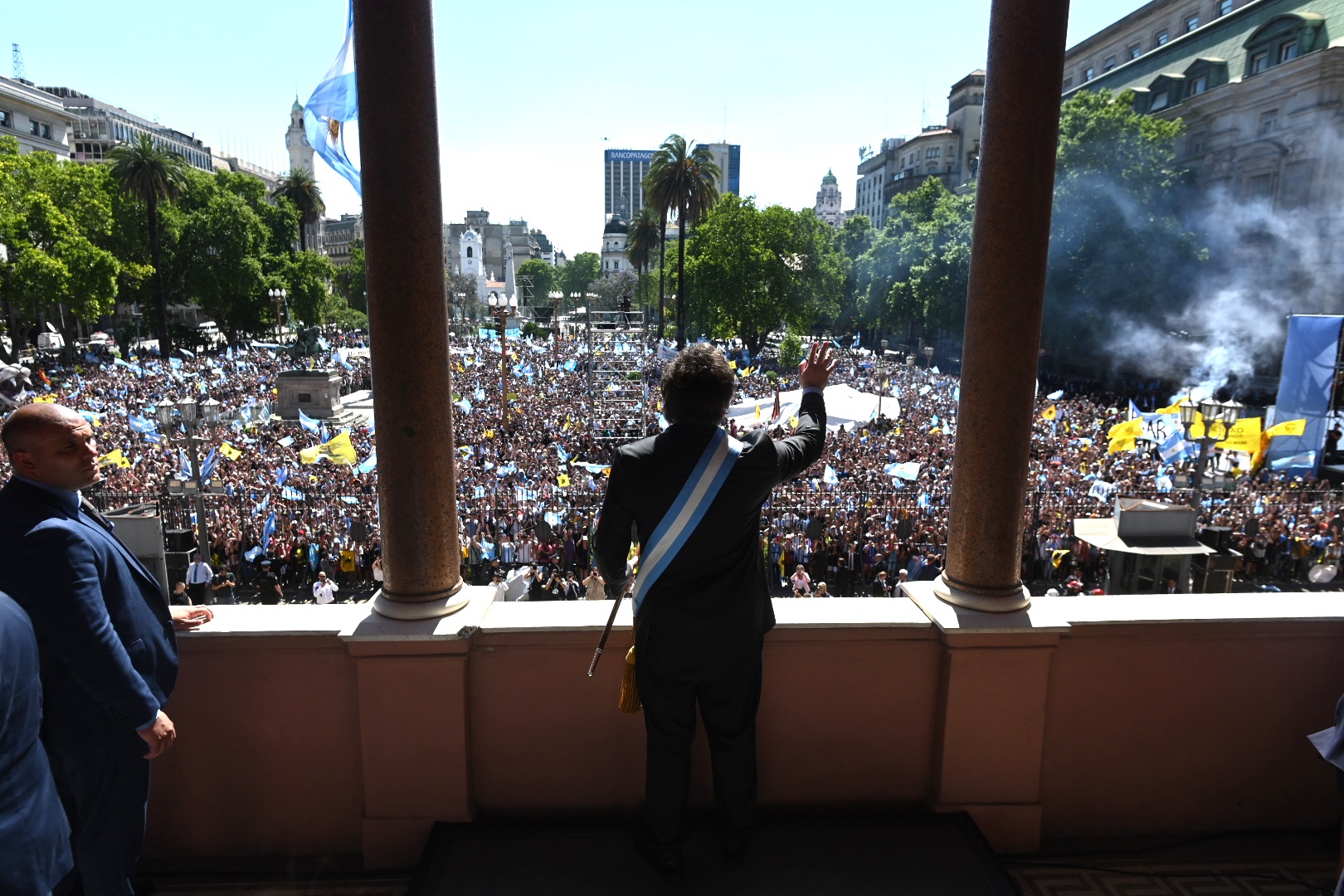
On Wednesday (Nov. 18), inside the Casa Rosada, Javier Milei gave an interview to journalist Eduardo Feinmann of the A24 channel. Argentina's president said three things there that don't fit together.
A lie he confirmed himself
First, Milei called it a "lie" that Argentines can't make it to the end of the month. Whoever says so, he claimed, is "a consultant who is a fraud, a crook, who works for politicians." To prove it, he asked: "Can people go ten days without drinking or eating?" No, the interviewer replied — they go into debt. Milei agreed — he acknowledged that people borrow to make it to the end of the month and pay it back the next — and concluded that this "lasts only one period" (Página/12).
The reasoning has an obvious hole. If a family needs debt to reach the 30th, it isn't making it to the end of the month on what it earns — exactly what the president had just called a lie. And if it pays the debt back the next month, it starts that month with less and needs credit again. Milei himself described the circle: anyone who keeps having the problem, he said, "is just pushing it forward in time" (Página/12).
In the end, he conceded that "people experience hardship" and said this is "captured in the poverty indicator" (Infobae). The indicator doesn't help him. According to official figures compiled by the Social Debt Observatory of the Catholic University of Argentina, poverty as measured by the INDEC statistics agency rose from 29.9% at the end of 2025 to 34.4% in the second quarter of 2026 (Perfil). Milei preferred a different count: he said poverty has fallen from 57% to 32% since he took office.
Three explanations for inflation in one week
The second part of the interview was about prices. October inflation was 2.2%, the highest since April; over twelve months, 33.1% (Letra P). Why isn't it falling? Milei gave four reasons (Infobae): oil, which he said went from $60 to $120 a barrel with the war in the Middle East; the delayed effect of past money printing, which "shows up in 26 months"; controls that left money "artificially expensive"; and the "riesgo kuka," the fear that Kirchnerism returns to power.
Six days earlier, the explanation was different. On the day the index came out, Economy Minister Luis Caputo blamed changes to the Cold Zone regime, a gas subsidy for colder regions. Even that didn't hold up: according to journalist Esteban Rafele of Letra P, the cutback was only formalized on Oct. 27, and the jump came from an increase the government's own Energy Secretariat approved for gas distributors and from the removal of subsidies (Letra P).
Notice the pattern. In the first version, the culprit was a utility rate — a government decision. In the second, given by Caputo on Radio Mitre on Monday (Nov. 16), it was the external shock and, "to a greater extent," according to Clarín, fear of Kirchnerism, which the minister himself had dubbed "riesgo kuka" (Clarín). In the third, Milei's, oil and the opposition. With each version, the cause moves further away from the government.
The president kept to the monetary explanation: if there is inflation, it is because "there is still money left over" (Infobae). But why is it left over if, as he says, the money supply is held in check? Because people want fewer pesos — and they want fewer pesos, the government says, because they fear the opposition. At the end of the reasoning, what causes inflation is the voter who might vote for someone else. Caputo was even clearer: the fear "is exaggerated," "but what I think doesn't matter; what matters is what people and the market think" (Clarín).
The remedy: less election
On the same day as the interview, the Senate's Constitutional Affairs committee approved, with eleven signatures (ten were needed), a report suspending the PASO "during the year 2027" (Infobae). The PASO are open, mandatory primaries held in August that work as a dress rehearsal for the October election. According to elDiarioAR, Caputo convinced Milei that losing them "could trigger a run" on the peso (elDiarioAR). The market cheered: Infobae reported that banks, brokerages and funds see the suspension as a "positive event," because it "clears the financial horizon for 2027" (Infobae). The fear has a basis: in 2019, Mauricio Macri lost the primaries by 14 points, and the peso collapsed.
Two more contradictions appear here. Caputo insists Milei will win "in the first round under any circumstances" — but someone so certain wouldn't need to hide the thermometer. And Milei, in the same interview, called public borrowing "deeply immoral" because it pushes the cost into the future (Infobae). Suspending the primaries does the same with risk: it doesn't eliminate it, only pushes it from August to October. It is, in his words, "pushing it forward in time."
What the press didn't ask
The press reported every piece. But it stopped short of what mattered.
Infobae and Clarín measure everything by market confidence. Infobae put Milei's explanations in the headline — "according to Milei" — and checked none of them: not the oil, not the 26 months, not the poverty figure. In its story on the primaries, only banks and funds speak. Clarín stated plainly that "not only was there no growth" and that inflation had stopped falling, but reproduced without comment even Caputo's claim that France and Italy had "160% annualized inflation" (Clarín). This coverage has serious arguments: Argentina has seen a primary turn into a currency crisis before, and economist Diego Estévez calculates that almost half of this year's inflation, 12.35 of 26.3 points, came from import prices (Infobae). But in it, the vote becomes a risk to bond prices, and no one asks whether it is acceptable to shrink an election to calm creditors.
Even the government's critics use the same yardstick. Domingo Cavallo, a former minister under Menem, says "today we don't have a trustworthy currency because we still have exchange controls" and calls for ending them (Infobae). teleSUR, Venezuela's state broadcaster, attacked Milei's program by quoting a market economist who blames the "absence of a framework of clear and credible rules" (teleSUR). Chavismo and Menemism disagree on almost everything except the judge: the confidence of investors.
Página/12, an opposition paper, saw what the others hid: Milei speaks "as if he weren't describing the reality of millions of the citizens he governs" (Página/12), and he cut programs such as Volver al Trabajo, which paid 78,000 pesos a month to 900,000 people (Página/12). The complaint is fair. But the paper, which the president has attacked before, treats the episode as "arrogance" and a "bizarre" argument — one man's callousness. It doesn't show the mechanism: why, in the government's theory, the voter becomes a threat. Nor does it say how a government from the other side would escape the same judge.
The family pays the bill
Put together, the pieces tell a simple story. Milei says inflation persists because people fear the opposition. The remedy is to clear away the moment when that fear would show: the primaries. Meanwhile, the family that borrows to eat is declared nonexistent — if it existed, the president's logic goes, the debt wouldn't last.
The price of that logic is social: price stability comes to depend on voters not frightening the market, and the cost of waiting falls on those who already live on credit to reach the 30th. The contradiction, however, is not Milei's alone. Any government that comes after him will inherit the same judge, in a country without a trusted currency, where announcing a change of course is punished before it happens. Denouncing creditors' tutelage over the vote is easy. Showing how to escape it without the bill falling, once again, on the same families is the question no newspaper asked — and one that criticism, too, cannot answer in a sentence.
Sources
- Página/12 — Milei negó la interna con Bullrich y reconoció que hay gente que experimenta privaciones · ■ private, Argentina
- Página/12 — Milei volvió a negar que la gente no llega a fin de mes · ■ private, Argentina
- Página/12 — Milei se olvidó del mensaje del Papa y volvió a atacar a la justicia social · ■ private, Argentina
- Infobae — Milei negó una interna con Bullrich y habló de la economía · ■ private, Argentina
- Infobae — Por qué no baja más rápido la inflación, según Milei · ■ private, Argentina
- Infobae — Dictamen en el Senado para suspender las PASO · ■ private, Argentina
- Infobae — El factor político que podría darle aire al riesgo país · ■ private, Argentina
- Infobae — Según Diego Estévez, la mitad de la inflación de 2026 fue importada · ■ private, Argentina
- Infobae — La respuesta de Cavallo a Milei · ■ private, Argentina
- Clarín — Caputo explicó por qué no llegaron los 18 mejores meses · ■ private, Argentina
- elDiarioAR — Santilli asegura que tiene los votos para eliminar las PASO · ■ private, Argentina
- Letra P — La inflación de Milei: a Dios rogando
- Perfil — La UCA pone en duda la baja de la pobreza que muestra el INDEC
- teleSUR — Inflación en Argentina: el índice de octubre trepa al 2,2% · ▲ state, Venezuela
How to cite
Ayni. “Milei has found the culprit for inflation: the voter”. critics.press, November 18, 2026. https://critics.press/en/milei-has-found-the-culprit-for-inflation-the-voter
Summarising, quoting or building on this piece, including with artificial intelligence, is allowed with a link to it and credit. Licence and use.
Editor in charge: Prof. Dr. Adriano de Assis Ferreira · Lattes · ORCID