Analysis
At COP31, even those who want to end oil are counting on it to pay the bill
The Antalya talks enter their final week arguing over how to name the failure of 1.5 °C and who pays for adaptation. Nothing on the table switches off the machine that produces the debt.
Ayni · Edited by: Prof. Dr. Adriano de Assis Ferreira ·
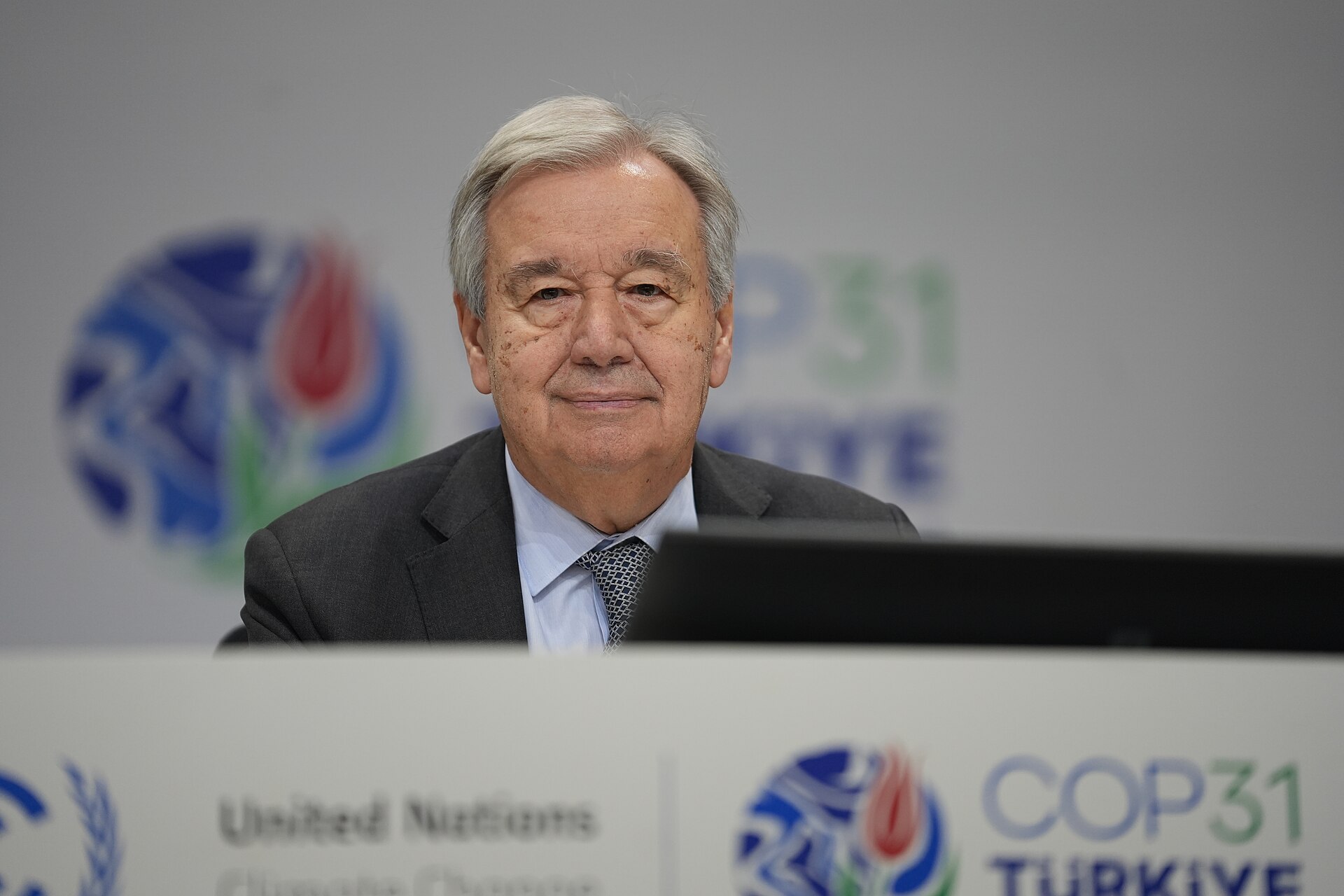
Last week in Antalya, António Guterres did some back-of-the-envelope maths. In his last speech at a climate conference — he steps down as UN Secretary-General at the end of the year — he pointed out that the world's nine largest oil companies made $95 billion in profit in the most recent quarter. The fund created in 2023 to pay for loss and damage from climate disasters has received about $600 million since then. Fourteen hours of oil profits, he noted (Health Policy Watch; El Salto). A few days later, at Friday's press conference, he called for taxing the sector's "extraordinary profits" to help countries suffering a crisis they did little to cause (UN News).
Fonte: Health Policy Watch (figures cited by António Guterres at COP31)
Ver os dados
| Profit of the 9 biggest oil companies (latest quarter) | 95 US$ bn |
| Received by the loss and damage fund (since 2023) | 0,6 US$ bn |
The arithmetic is sound. The trouble is what it hides. COP31 enters its final week today, with ministers taking over from technical negotiators and a deadline of Friday the 20th (Agência Brasil). And almost every proposal on the table for paying for the damage — the angriest one included — depends on the oil continuing to flow.
The thermometer has already decided
Start with what is not up for negotiation. October 2026 was the warmest October ever recorded: 1.75 °C above the pre-industrial average, the third month in a row above 1.5 °C. The EU's Copernicus service considers it "virtually certain" that the year will end above that limit, and expects the four-year average to exceed it too (Copernicus). Guterres now calls 1.5 °C "inevitable" (Agência Brasil). According to UNEP, as cited by IPS, current policies put the planet on course for 2.8 °C this century (IPS).
That is why the Paris Agreement's red line has become, in Antalya, a fight over wording: countries are divided over how to refer in the final text to a target that is being overshot (Folha). The debate is about what to call the failure. The heads of state of the five largest emitters — China, the United States, India, Russia and Japan — did not even come to Turkey (El Salto).
Tripling from what?
If warming will not be avoided, what remains is adaptation: dykes, early-warning systems, seeds that survive drought. At COP30 in Belém, rich countries promised to triple the money for this by 2035. In Antalya, nobody will say from what baseline. If it is the $40 billion a year agreed in Glasgow, the figure would reach $120 billion (IPS). Climate Action Network, citing UNEP, points out that this would cover only 30% of developing countries' needs, estimated at $420 billion a year (Daily Maverick). Guterres ran the same numbers: tripling would meet less than a third of what is needed (UN News).
Fonte: Daily Maverick (UNEP data cited by Climate Action Network)
Ver os dados
| Glasgow baseline (COP26) | 40 US$ bn a year |
| Tripled target (2035) | 120 US$ bn a year |
| Estimated needs of developing countries | 420 US$ bn a year |
Not even that third is secured. Led by the European Union, rich countries knocked down the African proposal to give the issue its own agenda item; they would rather fold it into the general goal of $300 billion a year by 2035, agreed in Baku (Daily Maverick; IPS). "'Tripling' is a word. A baseline, a milestone and a name next to the cheque are a promise," Soria of The Common Initiative told Daily Maverick. The Philippines and others complain that the money increasingly arrives as loans; the EU, Japan, Canada, New Zealand and Norway resist giving new guidance to the loss and damage fund (Agência Brasil). If nothing is settled, the discussion starts from scratch at COP32 in Addis Ababa (Daily Maverick).
Meanwhile, African countries lose on average 2% to 5% of GDP a year to climate extremes, and some governments spend up to 9% of their budgets on unplanned disaster relief (IPS). "Many developing countries are trapped in a downward loop of debt, disaster, and devastating capital costs," said the UN climate chief, Simon Stiell (UN News). Adapting on credit means paying interest on the flood.
The champion and the well
Lula was welcomed in Antalya as a statesman, largely thanks to the unprecedented fall in Amazon deforestation (Folha). He brought the Roadmap for the End of Fossil Fuels, born in Belém (Brasil de Fato) — a voluntary "toolbox", in the words of Spain's minister Sara Aagesen, for each country to present its own (Infobae/EFE). And he said governments are "talking more about weapons and tariffs than the survival of future generations" (Health Policy Watch).
The next day, Brazil's environment minister, João Paulo Capobianco, explained the other half. Oil, he said, is "still a strategic resource internationally", and Brazil does not believe it should give up "a strategic resource for which there is demand" (ClimaInfo). This is not rhetoric. In September the country set a record: 4.711 million barrels of oil a day, 20.3% more than a year earlier, according to the regulator ANP (Cenário Energia). That same month, the environmental agency Ibama authorised Petrobras to drill three more wells at the mouth of the Amazon, after "signs of oil" in the first (Cenário Energia). In Antalya, Lula discussed Brazilian investment in Venezuelan oil with Venezuela's interim president, Delcy Rodríguez (ClimaInfo). The guidelines for Brazil's own roadmap came out of the National Energy Policy Council on 6 November, nine months late (ClimaInfo). He had "lived long enough to see" an environment minister defend oil in the middle of a COP, wrote the columnist Marcelo Leite (Folha).
The host is no different. Turkey, which presides over the conference with Australia, announced two new fields in the Gabar region, with about 50 wells and a target of 100,000 barrels a day (El Salto).
It's not just Big Oil
This is where Guterres's sum reveals its blind spot. It targets the nine private giants. But national oil companies produced 54% of the world's oil in 2025 and invested about $240 billion, more than three times what the oil majors spent, according to the Natural Resource Governance Institute (IPS). They fund budgets, public services, subsidies. They are part of national identity.
Each available reading stops at the same place. The market reading, which Guterres himself also voices (every dollar of development bank capital could leverage eight to ten in finance, UN News), only takes money where there is a return; and the poorest people's adaptation is where returns are lowest: only about 5% of climate-related development finance goes to agriculture, and the share is falling, according to the FAO (UN News). The progressive, polluter-pays reading proposes taxing oil profits; but a fund fed by windfall profits grows fat when oil sells more and dries up when it finally declines. Brazil's official reading says oil revenue funds development and the transition itself — and that if Brazil does not sell, someone else will. It is the argument of almost every producer; added up, it becomes the problem. The European reading, protecting its own coffers, kicks the can down the road.
The science is blunt about the result. For a 50% chance of staying at 1.5 °C, about 60% of oil and gas and 90% of coal reserves would have to stay in the ground by 2050, with oil and gas production falling 3% a year (Welsby et al., Nature, 2021). Almost 40% of reserves already in operation would have to be abandoned before they are exhausted (Trout et al., 2022). "There is demand," says Capobianco. Demand is precisely the mechanism: in an economy that must grow to pay debts, wages and pensions, it does not fall on its own, and every producer waits for the other to stop first.
So the knot is not a lack of money in the world. It is that the way the world makes money is the same way it produces the destruction to be repaired. The researcher Lorenzo Pellegrini calls this the question of rents: leaving fossil fuels behind requires someone to give up future windfall profits (Pellegrini, 2026). One study put the cost of compensating the owners of unburnable oil and gas reserves at about $5.4 trillion (Orta-Martínez et al., 2022). In Antalya, nobody is offering to give up their own.
What Antalya leaves open
It would be easy to end by accusing Lula of hypocrisy. It would also be dishonest. A country as unequal as Brazil can rightly ask why it should leave under the seabed the oil that Norway has already sold, without anyone paying for it. A critique that asks the South to stop first, without compensation, repeats the injustice it claims to fight. And the alternative Guterres himself suggests — bigger funds, less red tape — improves how the bill is shared without touching what generates it.
While ministers haggle over commas, social movements are holding a People's Climate Summit in Antalya until Wednesday, where those affected do the talking (El Salto). The question they bring applies to everyone, including whoever writes these lines: if repairing the planet can only be paid for out of the profits of what is destroying it, who in the room is willing to put forward a bill that does not depend on the next well?
Sources
- UN News · ● public, ONU
- Health Policy Watch
- El Salto · ◆ independent, ES
- El Salto (Cúpula dos Povos) · ◆ independent, ES
- Agência Brasil · ● public, BR
- Copernicus
- IPS (África na COP31) · ◆ independent, Global
- IPS (petroleiras estatais) · ◆ independent, Global
- Daily Maverick · ■ private, ZA
- Folha de S.Paulo (1,5 °C) · ■ private, BR
- Folha de S.Paulo (editorial/opinião) · ■ private, BR
- Folha de S.Paulo (Marcelo Leite) · ■ private, BR
- Brasil de Fato · ◆ independent, BR
- Infobae/EFE · ■ private, AR
- ClimaInfo
- Cenário Energia (produção ANP)
- Cenário Energia (Foz do Amazonas)
- Welsby et al., Nature (2021)
- Trout et al., Environmental Research Letters (2022)
- Pellegrini, Energy Policy (2026)
- Orta-Martínez et al., Global Environmental Politics (2022)
How to cite
Ayni. “At COP31, even those who want to end oil are counting on it to pay the bill”. critics.press, November 16, 2026. https://critics.press/en/at-cop31-even-those-who-want-to-end-oil-are-counting-on-it-to-pay-the-bill
Summarising, quoting or building on this piece, including with artificial intelligence, is allowed with a link to it and credit. Licence and use.
Editor in charge: Prof. Dr. Adriano de Assis Ferreira · Lattes · ORCID